The Story…
The morning was gloomy and socked in with coastal mist that refused to burn off. Rain was scheduled into the forecast, a welcome event in our dry neck of the woods. Our crew sat spaced around the breakfast table for some coffee while we plotted out our day. I made it to a single sip before the tones interrupted our casual morning meeting. Vegetation Fire Freeway. This should be a quick one, I thought, as the lingering mist looked like it might even rain sooner than predicted.
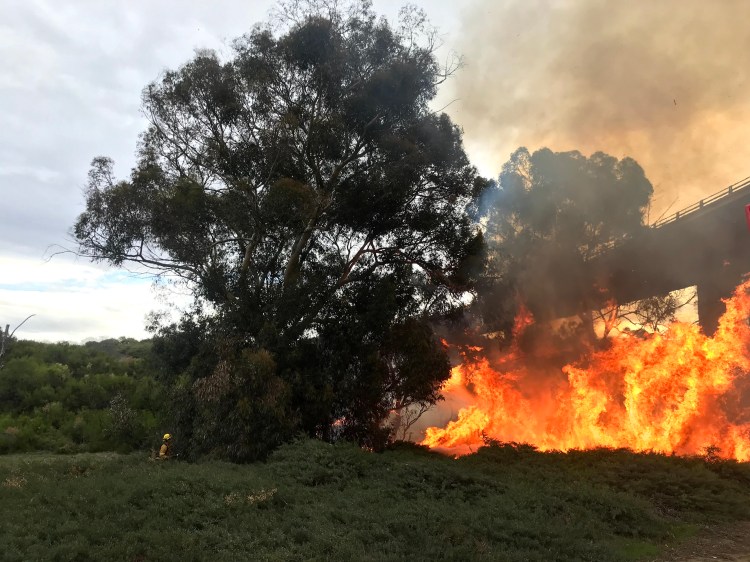
As we sped out onto I-5 South towards San Ysidro, I was slightly surprised. 20 ft. foot tall flame lengths lapped up some massive eucalyptus trees adjacent to a freeway merge cloverleaf. Cars made their way past slowly through flames that shot over the side of the freeway, horizontally. The fire had burned west and stopped abruptly at 5 lanes of northbound highway. The fire had run out of fuel (vegetation) to burn. Once we turned around and got into position, it seemed like a done deal. Despite the impressive flames burning in the center of the active fire front, the fire had nowhere to go but die in the pavement. The two engines, with 1,000 gallons of water between them, would be plenty to contain the mess.
Our engine arrived first and we spotted our rig on one side of the fire. My firefighters began gathering brush cutting tools and stretching a hose line. I gave a brief size up of conditions on the radio, established an incident command, and gave the second arriving engine the assignment to extinguish the other side of the fire. With the wind in our favor, we would fight the fire from upwind, put one foot in the burn, one foot in the unburned. One foot in the black and one in the green is what we say. Working from this safe posture, with hand tools and hose lines we’d work from opposite ends to extinguish flames that still might be burning along the flanks. The mass of fire was less than a quarter acre and actively burning, but burning to the freeway. It should have been easy work.
Problems started shortly after my firefighters began flowing water from their hose. The fire, which had been in steady decline due to burning itself out in the pavement, suddenly became fueled by a wind shift that caused the flame front to pivot into a fresh patch of waist high acacia brush. Despite the drizzle that peppered our rigs windshield, the fire picked up in ferocity, doubling in size before my eyes in seconds. I am incredibly lucky to have a crew of professionals, and my guys easily reposition to attack the fire from a safer and more advantageous angle, but as the incident commander, I needed to adjust my tactics quickly. As calmly as I could, I ordered up a water tender, a brush apparatus, and another engine for additional support, which more than doubled the personnel and water required to fight this fire.
At first, it was chaos. We ran out of water and it was a long wait in a steady rain for the reinforcements to arise. We made productive use of the hiccup and figured out how we would cut fire breaks in the brush with hand tools. The fire grew more and more with each gust of the wind, but armed with a plan, we positioned rigs appropriately, developed a sustainable water shuttling operation for effective hose streams, and quickly extinguished the fire.
Firefighter Economics Lesson…
All and all it was an OK operation, but let’s call the failure. I failed in appreciating the exponential growth potential of that fire. In economic terms, I failed to appreciate compounding interest. What is compounding interest? It is the ability to make something benign, be it fire or a credit card debt, grow rapidly into a large problem. Harnessing the same power, compounding interest can also be used for good in hose streams ability to control fire or an investment account’s ability to make you rich by retirement.
How does it work?
Compounding interest takes into account growth rates and reinvestment. For instance, a brokerage account that gets you 10% return on your money invested per year with a starting balance of $1,000 would see you earn $100 on your investment by the end of the year. If you choose to, you could spend that earning, or you could unleash the power of compounding interest by reinvesting that $100. With that, the next year your 10% calculation would be based off of $1,100 ($1,000+$100) and you’re off to the races. The exponential growth is staggering if it is left to it’s devices over a long period of time. Small amounts of initial startup money invested over a 30 year career, with small additions each month can lead to some massive accounts by retirement. In an instant gratification society, these gains will not get you rich quick, but in the long term your money and compounding interest becomes a force to be reckoned with.
The Rule of 72
Part of being a good company officer in the fire service is the ability to quickly anticipate how fast an incident can expand. Again, I failed to appreciate the exponential growth of that fire. As the fire burned, it reinvested the heat produced by drying out the unburned vegetation in front of it’s active fire flanks. With a slight push of the wind in the right direction, the fire roared ahead faster than I could anticipate. Trust me, on that fire I built a very valuable appreciation for exponential growth. With your investing account, it’s much more simple to size up your potential. By using the rule of 72, you can quickly approximate how fast it will take to double your money. All you have to do is divide 72, by your anticipated return on investment. For instance, a 10% return rate would take 7.2 years to double. Over the course of a 30 year career, that is a nice exponential growth. $100 invested on day 1 of probation would be worth, $200 by year 7, $400 by year 14, $800 by year 21, and $1,600 by year 28. Not bad!
Maximize Success
In my mind, the safest thing to do is to invest more up front early and use the power of compounding interest to my advantage. I learned a valuable lesson on that fire. I had a large area of fire already burning, when the winds shifted to promote growth. A larger bank account or initial starting investment coupled with the same compounding interest results in a massive difference in ending numbers. Going back to the same example from before, suppose we invested $1,000 instead of $100, at the end of 28 years, you’d turn that $900 difference into a $14,400 difference. Invest a lot early, and let the compounding interest work it’s magic.
But I Have Bills To Pay?!?!?!
This part gets me too, but reading quite a few personal finance books, I’m realizing that any little bit counts, and every little decision can make you rich in the long run. You don’t have to go crazy, although the more you get into this, the more addicting it has become for me. For instance, if you run your home cooking like station cooking, accounting $10 a day per person, a family of four can eat for $40 a day. Go out to eat for all those meals, and in San Diego, you’re probably looking at $100 pretty easy. Invest the $60 you saved by eating at home in that same 10% interest account. Compound that over almost 30 years and you’re looking at $960 for one decision you made. I plan on driving my old pickup truck for as long as I can and invest the $40,000 I would pay for a better truck. If I wait 7.2 years in a 10% interest account, the investment gains could buy me two trucks. As firefighters, the running joke is that the new firefighters spend their first few big paychecks to buy a brand new lifted truck. There has to be a better way!
The After Action Review
Compounding interest can make even smaller numbers of investments grow over time into a sizeable account. It is a foundational principle that you will probably hear often in this blog and something I see is incredible important in a fire service application. We got lucky on that fire and I learned a lot about exponential growth. Fires and investments double in size at predictable rates given conditions for success are met. My goal in finance is to find reliable a safe sources of income with higher interest rates to allow my investments to double, whether real estate, stocks, commodities, or businesses.
For More…
https://www.investor.gov/financial-tools-calculators/calculators/compound-interest-calculator


2 thoughts on “Explosive Growth With Compounding Interest”