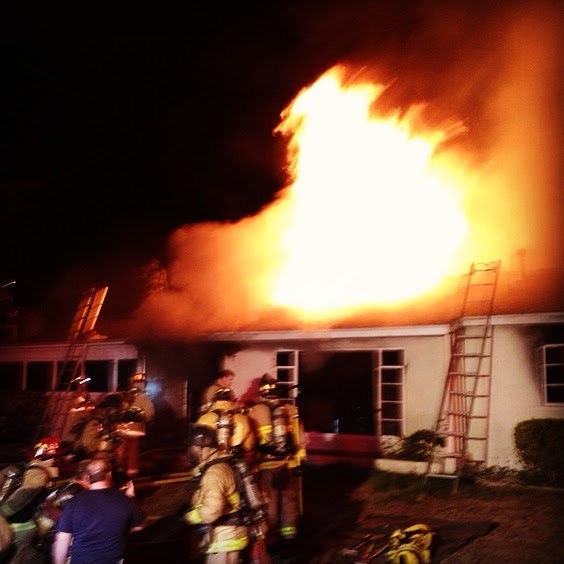
In the profession of firefighting, the idea of getting injured on the job is more of an inevitability rather than a massive “what if.” If you feel compelled to want to run into burning buildings, its only a matter of time before something catches up to hurt you. In our career, most of us are driven to be the firefighter who adds productivity to any fire scene, and the last thing we would want to be is the brother or sister firefighter that causes harm to another firefighter. A fire scene is an incredibly coordinated dance between various engine, truck and rescue companies. Solid training, clear communications, and sound objectives can make a chaotic scene that much more manageable. In the inherent risks of firefighting, we often fail to fully appreciate the human factor of decision making and execution of assigned tasks. In the finance world, this so-called counterparty risk is readily factored in to costs of doing business. In the firefighting world, underestimated counterparty risk is our worst nightmare and something we never wish to face.
I’d like to think we all aspire to be the best firefighter we can be. If you’ve read any of my other blog posts, I’m here to tell you that being that being that professional firefighter that makes the right call EVERY time is a wonderful goal, but entirely unobtainable. It’s not so cut and dry. Mistakes will be made, and in the process of learning, it is my absolute hope that I never cause harm to anyone. To my knowledge, I have thankfully never made a mistake that has caused one of my fellow firefighters harm. However, I have been on the receiving end of this counterparty risk. Sometimes it has come from firefighters more experienced than myself. In the world of firefighting, conditions can become so chaotic and dynamic, and I unequivocally forgive each and every one of these mistakes. I’d like to share one of these instances.
One cold spring night, we responded to a well involved structure fire. It was a district or two away from us, but we had already been on the road and were fortunate enough to arrive second in. Heavy fire blew out of some rear windows and smoke pumped out of the front door. I pulled a backup line and grabbed a pike pole for my partner, who was a brand new firefighter. We ducked inside the living room and found the other firefighters at the end of their hose line. The heat was intense, but I couldn’t see any active fire. I told my partner to stay close as I yelled to the other firefighters that I didn’t see anything and was going to try and pull some ceiling down to see if the fire was running the attic above us. I stood up from a crouched position and managed to poke a couple small holes in the lathe and plaster ceiling before crumpling down to the floor. “Jeeze it’s hot!” I yelled. My ears stung. “I can’t see any fire but its hot as hell everywhere!” the firefighter on the other crew yelled. I handed the pike pole to my partner and said “poke some holes up there!” He managed one or two before squirming down onto his belly in pain. Things did not seem right, but we heard our saviors on the roof above us and decided to give it a few more seconds.
For those not in the fire service, those saviors we heard on the roof above us were the truck company. Typically on fires, the engine companies carry the hose and go inside to extinguish the blaze, while truck companies remove the super heated fire gases by cutting holes in the roof at strategic places, essentially making an improvised chimney. This allows the hot air to escape, increase visibility and allows the interior firefighters to get to the seat of the fire more effectively. This process known as vertical ventilation usually requires coordination between interior crews so that the hole is cut in the right place and is opened at the right time.
Conditions were already hot as we cussed on our hands and knees, but a hole would be cut soon and we’d have some relief. We could hear the chainsaws humming away above us, cutting through the wood decking. Seconds later, the loud thumping of the firefighter punching the roof in to complete the hole would bring us back to fighting shape. However, things went immediately terrible. In a blur, I found myself cooking alive on my belly, inching out to the front door. I had one hand on the breathing apparatus of the firefighter ahead of me as we crawled out as close to the ground that we could manage. After an eternity, we all flopped out onto the lawn safe and sound. Our turnout gear was smoking. The rapid intervention crew firefighters were suited up and breathing air. One of them grabbed me by the straps on my SCBA and yelled at me in panic! “ARE YOU OK!?!?!?” “Yeah I think so,” I said. What is going on, I thought to myself.
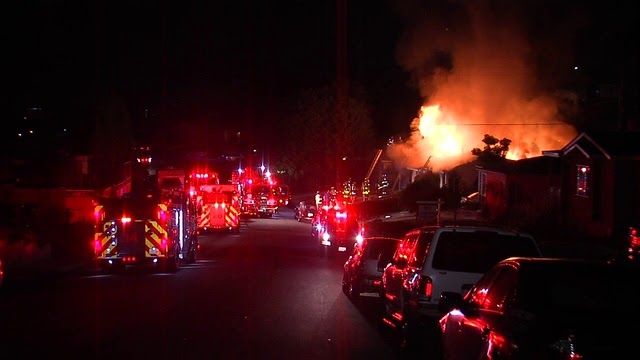
My captain suddenly materialized in the front yard, perhaps not fully aware of what we had just gone through. He had been surveying the fire from the exterior and getting ready to go inside with us. He said “Hey when you’re done messing around, grab that spare hose line and lets get to work.” Perhaps it was the adrenaline and humiliation surging through me, but I nodded my head and went back into the fire to make quick work of a fire that had engulfed two bedrooms, a kitchen and the attic. My ears continued to sear in pain, but it was nice to gain the upper hand after getting our butts kicked. When I went to exit through the living room to grab a new bottle, I was able to easily walk out without feeling the heat. Though my ears still stung, I didn’t think much of what had really happened. This was until the truck firefighter met me at the door with wild eyes. He grabbed me forcibly by the straps on my SCBA and said “I am so sorry! Are you OK!?!? I’m so sorry.” Confused, I said. “Sorry for what?” “I thought we killed you guys in there!” he blurted…shocked, I was about to learn my fist lesson in extremes of counterparty risk.
Counterparty Risk: A Human Factor
When I look back at this fire, I see so many great lessons to be learned about counterparty risks. All of them are forgivable and all of them are things I bring with me to every fire since that wild night that left me with second degree buns on both ears. Fundamentally, all that happened involved us not fulfilling our obligations that training and standard procedure seek to instill in our crew interactions. For instance, as an interior crew member, I should have radioed valuable information or talked face to face to my captain about where we wanted a ventilation hole to be cut. Conversely the ventilation team should have radioed us to seek the needed information and also ask us if we were ready for a hole to be completed. We all failed miserably, a hole was cut behind us and without input from us. As a result, super heated gases flowed freely in the attic above our heads while igniting everything in the attic. The resulting fire blast intensified the heat in a room that was already hot from a fire burning behind two adjacent walls. We were lucky to get out! Another crew inside experienced the same rapid change of conditions in a different part of the house. They had to jump headfirst out a window because the heat was too great and the door was too far away.
I can’t stress enough how lucky we got during this incident. I want to be clear when I say everyone involved did not fulfill his or her obligations to coordinate an effective fire attack and ventilation operation. We paid a small price, but we learned a lot. Yes, this fire was a tough one to begin with, but with commitments towards coordination and communication, it could have gone way better for our crew safety. I bring this example up because it highlights the wildcard that is human nature. It lives with us in our every day interactions and in some extreme circumstances, even the most seasoned firefighters can fall prey to or increase their respective counterparty risks. Under normal circumstance, and especially under times of duress, communications and coordination can go out the window. The same happens every day in the business world, with detrimental effects to the financial well being of net worths and balance sheets. However, whether it is in the fire service or in personal finance, counterparty risk is a necessary risk with almost identical guidelines.
Risk Levels Change With Reputation
If you are a probationary firefighter or a recent high school grad with a new job, you reputation is a big unknown and your status in this world is priced accordingly. You might pay a higher interest rate or not even qualify for certain types of financing. This is because your reputation hasn’t been established. This huge unknown is priced accordingly by lack of access to credit, or expensive access to credit in the form of higher interest rates. In the world of firefighting, a “probie” needs to be monitored closely in order for an operation to be successful. There is high counterparty risk in these cases because both reputations haven’t been established. The student can’t borrow as much money and the bank is more hesitant to lend and the new firefighter isn’t as competent and their captain will have to devote more time to supervise that could otherwise be devoted to overall incident progress. In both cases, you see capital inefficiency and incident inefficiency. However, with time and repetitive successes, reputations build towards more efficient financing and fire ground operations. Anyone wondering why we always pick on the new firefighter to take the lead in all the drills, cooking, and cleaning can now know the truth…it isn’t hazing… we are merely reducing the counterparty risk through repetition in the basics.
Counterparty Risk Is A Necessary Evil
Whoever invented the phrase “If you want something done right, you need to do it yourself,” was probably never in a high stress profession like firefighting. Delegation and coordination are key to incident success, and incidents that function without coordination are either poorly run or small enough to be handled by a single company. In order to thrive in the chaos of the fire ground, you need to accept counterparty risk. You need to coordinate and communicate well with others. You need to expect the same from them. The same holds true in the finance world. If you want to get ahead in your financial future, you will inevitably need to accept some degree of counterparty risk. You will need to work with and rely on other people, who in turn will need to rely on you. Some people argue that physical gold in your possession is a perfect example of an asset that has zero counterparty risk. This is incredibly true! Assuming you have somewhere safe to store it, you do not need to rely on anyone to keep your net worth in tact. However, gold does not yield any interest rate, therefore no growth in the real value of your wealth. In order to get ahead in this world, you will need to work with other people and businesses an accept some degree of counterparty risk to grow. On the fireground, you will need to trust and work with crews and people you might not have worked with before. The cost of not doing so would be worse than the incident itself.
The Risk Can Be Managed
It’s important to note, the counterparty risk never goes away. People with stellar credit default on their homes, and seasoned truck firefighters don’t coordinate ventilation holes and cut them in the wrong place. Stuff happens. We can manage counterparty risk by training or doing business together and building a mutually beneficial relationship built on trust. Start small and always have contingency plans if working together isn’t effective or profitable. Committing to adequate communications, expectations, measurable and achievable goals, and timelines are all key towards reducing the counterparty risk factors. We also need to realize that underlying risk factor change. Any landlord with a tenant who hasn’t paid rent for the last year and a half can attest to this fact. Any supervisor in the fire service knows that their people’s mental health, attention to work, and job performance ebs and flows to the beat of hundreds of personal and professional factors and it is up to them to understand and manage those risk factors as best as possible for the good of the crew.
In Closing
Counterparty risk is the human nature factor in every interaction we have in the fire service and financial world. Accepting this as a necessary risk, fostering productive relationships, and laying out clear expectations are key towards mitigating risk. And finally, expecting the unexpected and always keeping your finger on the pulse of your professional brother and sisters as well as your business ventures will ultimately allow you to thrive in a world with various degrees of counterparty risk.
 The Firefighter Economist
Great article. “In order to get ahead……you will need to work with other people.” Thanks for educating!
LikeLike