Like most new firefighters, I was an absolute train wreck on the fire ground during my first few years, namely my probationary year. For our department, your first year on the job after the academy is known as the probationary year. As a “Probie,” you need to demonstrate proficiency in basic firefighting skills on real life incidents. Technically, if you don’t demonstrate the bare minimum skills, the powers that be can fire you at any moment. Seeing “probies” operate on a fire ground is hardly ever pretty. To separate you from the masses, the department identifies you by giving you a bright orange shield on your helmet. It gives everyone on scene the warning that you might be doing some things that make no sense. You might need some extra guidance.
It’s a right of passage to be the idiot, the kid, the boot, or the probie, but if you’re successful in your probationary year, you ditch the orange shield and become a full fledged firefighter….in name only. If you aren’t careful to learn everything you can your first year, you essentially go from “Probie” to idiot overnight. I was one of those idiots and looking back, I should have done everything in my power to learn how to read the fire scene better. Even if you are proficient in the basics, you are no use to the scene if you don’t even know where you are or what the scene is doing. That was my problem. I repeated the problem over and over and over fire after fire. I could operate only if someone told me what to do. My captains got used to me floundering a lot and told me what to do quite often. I was a robot, incapable of seeing the bigger picture until I finally committed to learning the art of reading smoke.
As the saying goes, where there is smoke there is fire. If you can read the smoke coming from a building, you utilize several factors such as color, volume, velocity and density to evaluate the severity and possible location of a fire. It is an art more than science. I really took the time to learn the basics. Once I unlocked these skills, firefighting like a smart and well seasoned firefighter became easier. I could accurately guess where the fire was at and where it was going. It was like all the mystery and chaos of the scene became more manageable. It was life changing! I was able to stress less about the what if’s and focus on making my strategy and tactics streamlined in efficiency. My captains noticed the difference and I felt like I was being micromanaged less. I felt like I was part of the team. It worked well for me in my firefighting hey day, working in Southeast San Diego, but one day my confidence got the best of me and I got humbled quick.
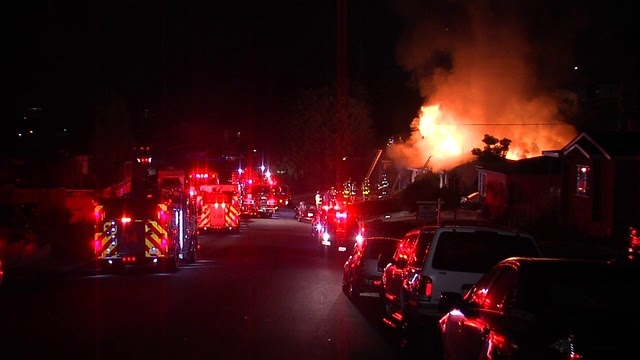
You see, I was working an overtime shift downtown and our crew got dispatched to a high rise fire in the early morning. On arrival to a five story high rise office building, we saw light wispy smoke lazily coming from a fourth floor open window. It seemed like a small fire. Piece of cake I thought. We grabbed our equipment and trekked up to the fourth floor with hose packs and forcible entry equipment. None of the other floors had any smoke on them, so we established a Division 4 (fourth floor ops) and set to work looking for a fire. It was all cold lazy smoke banking down to the floor. It was lighter smoke but thick enough that I couldn’t see my hand in front of my face. Armed with a thermal imaging camera, we searched a large open office area for the duration of a whole 30 minute bottle but couldn’t find anything. It was frustrating. We trekked back down the stairs to get a new bottle and decided to check the alarm panel to see if there was any information that might help us out. WATER FLOW AND HEAT DETECTOR ALARMS IN THE BASEMENT, SMOKE DETECTORS 4TH FLOOR.
Hmmm had anyone check the basement? I let my captain know and we decided to go check things out after grabbing a new bottle. What did we find in said basement? Oh just a ripping inferno that ended up kicking all of our asses. The thing about basement fires is that you have to fight your way through the hottest part of the thermal layer to get to the seat of the fire, and this was no different. It took some creativity, namely blindly spraying water into the unknown blistering heat, but we were finally able to get knockdown on the fire in the basement. There was no fire on the fourth floor. The building was sealed up so well that the smoke from the basement fire had traveled upwards by whatever means (void spaces, utility pipes, etc.) to ultimately find an open window to vent out of. Although the smoke I read initially was benign, I failed to realize the bigger picture.
The lesson here was that I had used my art of reading smoke the wrong way. I failed to appreciate one of it’s cornerstones, and that is to compare the smoke characteristics to the size of the building. My streak of responding to structure fires leading up to this incident had been in small single family homes. My reference point was to evaluate fires in 1,000 square foot homes and not 50,000 square foot office buildings. On this incident, I learned the hard way that a small fire in a small house looks about the same as a massive fire in a high rise building. It’s all relative, but one of those scenes is more unforgiving than the other. Moving forward, I learned that when reading smoke, you always have to calibrate the conditions to the building. A similar concept reads true in economics and personal finance.
In economic terms, you need a way to compare conditions across the space of time. For instance, all the old timers on the job are complaining about the cost of gas rising significantly. It used to be $1.25 and now it is almost $4. The other day, some economist on CNN pissed off the old guys sitting around the breakfast table when they said “in real terms, the price of gas has actually fallen.” “Bullshit!” The old salts replied with disgust. Who is right? In the case of San Diego City Firefighters, I would like to say the TV and the old guys are both right, but for different reasons which I will explain. But first, the two terms you need to realize in this lesson are nominal value and real value.
When we talk about prices on TV or in day to day conversation, chances are, you are talking about nominal value, which is essentially the face value of something. Nominal value is what you would pay in a given moment in time. In firefighting terms, nominal value is how much fire you have on your scene, while ignoring the building it’s burning in. Nominal values are great for your average day to day transactions and investing, but when you begin to talk about building long term wealth and comparing things like expenses and investment performances across time, you really need to start looking at things in terms of real values. In firefighting terms, assigning a real value to the fire takes into account what occupancy the fire is burning in. The assessment is then calibrated so the best decisions can be made. In economics, real values are derived by taking the nominal value and adjusting for inflation.
I go into what exactly inflation is in this post here, so I won’t touch on it much. Instead, I’d like to give you an example of why nominal and real values matter. I am going to use my fire station as an example. According to the City of San Diego website, Fire Station 30 was constructed in August 1959 at a cost of $84,800. Nominally, this seems like a steal! Hell, I’m trying to add another room and bathroom to my house and they are quoting me about that much for a basic job on the lower end of quotes! In order to really get a good picture for what is going on, we need to convert these figures into real terms by accounting for inflation. I use an online inflation calculator to determine that $84,800 in 1959 is worth $784,458 in today’s dollars, a markedly big difference! Side note…typically real values of things such as housing and food typically have an average price consistent across time. If the two bedroom, one bathroom house down the street from the station is currently on the market for $900,000, and in today’s terms our fire station that sleeps 6 has a real value of $784,458, anyone else think the housing market is insanely expensive, even in real terms?
Ok, so back to the angry old firefighters. If we adjust the nominal price of gas for those firefighters from when they first got on the job to reflect the real value, YES, gas is cheaper now in real terms. However, I get their frustration, because we have not received cost of living raises that keep pace with inflation. Hypothetically, if I got on the job in 2000, making $50,000 a year, never promoted and only have received a 10% pay raise over the last 21 years, my nominal wage would be $55,000 per year, but my real wage, compared to 2000 would be about $35,000, a staggering $15,000 a year reduction in real purchasing power! Yeah I’ll be bitter if I don’t do something to ensure my real wage stays constant. This is why finding investments that outpace inflation are so important! They retain and even grow real wealth!
Wrapping this all up, as a probie, I learned that sizing up a fire and reading smoke was critical to being able to frame my emergency and then aggressively and efficiently put any inferno out. Essentially, I learned how to nominally assess any fire scene. By learning my lesson and adding the extra layer of assessing the building in which the fire was burning, I was able to see the real extent of the fire threat. In order to make what little dollars I have work for me in the future, it would be incredibly important to figure out the real price of an asset so I can buy the asset cheap (as expressed in real terms) and sell the asset when it is expensive in real terms. The principle applies for evaluating return rates. A 10% nominal rate of return will increase my real purchasing power by 7% when inflation is 3% (10% nominal minus 3% inflation=7% real), but that same real increase in wealth won’t be realized if inflation kicks up to 5% (I will only be 5%). Thus, it is always important to see if you are finding real (not nominally denominated) deals when purchasing assets for long term wealth preservation and growth.
Useful Links
 The Firefighter Economist