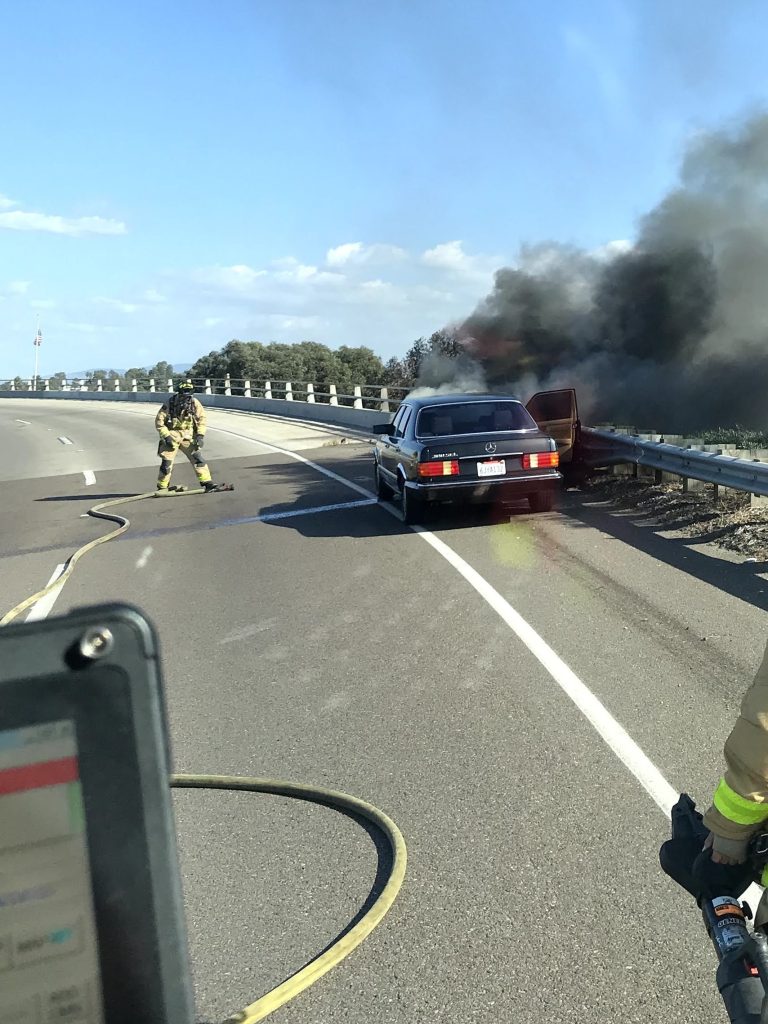
Imagine you get dispatched to a car fire on the freeway. When you arrive you see a small fire brewing under the hood and it’ll be business as usual. You’ll pull a hose line, force the hood open, spray some water and when you’ve chased down all the hidden fire, you’ll make the most junior crew member call the fire out (if we come back, its a huge shame for the whole crew and its really just a right of passage as a new firefighter to call the fire completely out). It should go this way, but this time around it’s different. You begin spraying water, but the fire keeps burning. You change the settings on your nozzle to add more gallons per minute, but the fire gets bigger. You keep the nozzle opened up on full blast, reposition and try from a different angle….no change. At this point, the engineer (or apparatus operator) starts to panic. You’re going to run out of water and there’s no hydrant in sight!
In this world, the cooling power of water has lost it’s fire killing power and you’re screwed! With no hydrant in sight, the crew swallows their pride and calls for another engine to respond with 500 more gallons of water. That engine arrives and gives the first engine water. At this point the fire has spread from the car’s engine compartment to the passenger compartment. Fire engulfs the whole car. No amount of water is helping. The firefighters pull a hose line with more gallon per minute ratings to see if they can quell this out of control chain reaction. No luck and the second apparatus is out of water. They leave to try and find another hydrant and at this point, the captain doubles down on asking for help. They call for a water tender, which lumbers down the freeway with 3,000 gallons of much needed H20.
This is the deciding factor. That and the fact that the burning wreckage has been reduced to a frame of rusted metal. Three crews pack up in silence and then reconvene to do an after action review, on what went wrong. After all, most car fires go out with waaaaaaaay less than 500 gallons of water. It wasn’t the tactics of the firefighters. It wasn’t some new whazooo material burning. The captain made appropriate size up of the situation on initial arrival. The realization is harrowing…on this day, they make a terrible discovery…water does not put out fire as great as it used to. In fact, the cooling power of water has become powerless in stopping the fire.
Uh…Economics?
Yeah, I’m pulling your leg. You probably won’t be able to change physics and water will probably be our chosen cooling agent for all time, but I wanted to use this example to explain the threat of inflation on your well earned pay check. Analogy time…if the car fire is all your bills, and the water your paycheck or other sources of income, inflation is the mystical force that forces you to dump a ungodly amount of water on a fire that used to take only a few gallons. Inflation is bills getting more expensive. It’s the frustration of shopping for chow with $10 a person and feeling like you aren’t feeding the troops adequately like you could when you first got on the job 10 years ago. Inflation is the erosion of you purchasing power. If inflation is measured at 2% per year, that’s two percent less you can buy with your well earned paycheck if you don’t get a raise. Yeah folks, the threat is very real…
What Causes This?
The exact weight of the causes of inflation are often debated by economist, but in general, inflation is caused by:
- The overall increase in raw materials and/or labor to make products over time. If the demand for a certain product, say a new fire engine is constant, but the cost of the steel and the wages of the workers that made the engine go up, you will see an increase in the price due to supply side costs.
- The demand for a product increases given a fixed supply. Toilet paper and bottled water with the COVID 19 panic pushing demand up, I’m looking at you. Those prices were ridiculous!
- An increase in government spending without raising taxes. Hmm COVID-19 Stimmy checks are calling hard on this one. When the government spends money they don’t have, someone has to pick up the tab whether they raise taxes or not. Inflation in this context is often called “the silent tax.”
- The Federal Reserve printing more money. If you have a fixed number of goods and services in the economy and you add more money to the circulating money system, it makes sense that all things being equal it would take more money to buy the same things.
How Bad Is It?
Inflation for the average person is generally measured by CPI or consumer priced index. CPI measures a basket of goods and services over time and calculates the average change in prices over time to get a measure of inflation. You can get up to date inflation data from the US Bureau of Labor. This doesn’t really mean much to me at all, so my plan is to develop a list of items I commonly buy and track those over the course of time to figure out what my own personal inflation rate is. More on this later. In general, my main concern is with the purchasing power of my defined benefit retirement plan in the absence of any pensionable pay raises. A quick example to drive the point home…If I make 50k a year and get to retire after 30 years with 90% of my wage, that sounds great if my bills are 40k a year. However, if I do not receive any raises that match inflation and inflation is 2% per year, after 30 years, my purchasing power will only be 30k (in today’s terms) leaving me with a 10k per year deficit to make up for…OUCH.
The Take Away…What Can I Do About It?
Well for one, I am in the process of doing my own homework and researching good investments that grow with inflation instead of leaving your money in savings. At this point, I really don’t know what my plan moving forward will be, but all I know is keeping dollars in a savings account will erode my savings purchasing power and this is not the way to go. The purpose of this post is to identify what inflation is in firefighter terms, and then in subsequent posts, I will dive into this a lot more because I feel like inflation is a huge threat to those of us with defined benefit retirement plans when we do not see cost of living adjustment raises that match inflation. More on this later!
 The Firefighter Economist
2 thoughts on “Tactical Terms: Inflation”